

Deciding between a porch vs. patio for your home’s outdoor spaces is essential, as these extensions of your living area provide opportunities for relaxation, entertainment, and connection with nature. When considering how to enhance your property’s exterior, this critical choice impacts both functionality and aesthetics.
At Blue Collar Scholars, we understand that creating the ideal outdoor living space requires careful consideration of your unique needs, property characteristics, and lifestyle preferences.
Our expert outdoor living space services in Maryland, Virginia, and Washington D.C. can help transform your outdoor vision into reality, whether you’re leaning toward a welcoming front porch or a versatile backyard patio.
Key Takeaways:
- Structure Matters: Porches are elevated, attached structures with roofs, while patios are ground-level spaces typically made of stone, concrete, or pavers.
- Budget Considerations: Porches generally require higher investment due to roofing and structural elements, while patios offer more cost-effective solutions.
- Climate Adaptability: Porches provide protection from weather elements and can be screened or enclosed, while patios offer direct outdoor exposure with optional shade additions. Check out these patio flooring ideas!
- Value Addition: Both porches and patios enhance property value, with porches typically offering stronger curb appeal and patios providing excellent entertainment spaces.
- Professional Expertise: Blue Collar Scholar’s experienced team can design and construct the perfect porch or patio solution tailored to your specific needs and property characteristics.
Porch vs. Patio Defined: Understanding the Fundamental Differences
The terms “porch” and “patio” are often used interchangeably, but these outdoor spaces have distinct characteristics that set them apart. Understanding these differences between a porch vs. patio is crucial for making an informed decision about which option best suits your home and lifestyle.
Porch vs. Patio: Key Characteristics Comparison
| Feature | Porch | Patio |
|---|---|---|
| Structure | Attached, covered structure extending from home entrance | Uncovered, ground-level space adjacent to home or in yard |
| Elevation | Elevated above ground with foundation | Built directly on ground without elevation |
| Coverage | Has roof providing protection from rain and sun | No built-in roof (may add awnings or pergolas) |
| Support | Requires columns or posts | No structural supports needed |
| Enclosure | May include optional railings, screens, or glass | Typically open on all sides |
| Access | Direct access to home entrances | May connect to home or stand separately |
| Position | Often at front or back of house | Typically at rear or side of home |
| Materials | Usually wood or composite materials | Concrete, pavers, stone, or brick |
| Design | More defined by home architecture | Versatile in shape, size, and design |
| Integration | Transitional space between indoor and outdoor | Seamlessly integrates with landscaping |
| Weather Use | Usable in various weather conditions | Best in fair weather unless additions installed |
| Function | Ideal for relaxation, reading, and greeting guests | Perfect for entertaining, dining, and enjoying sunshine |
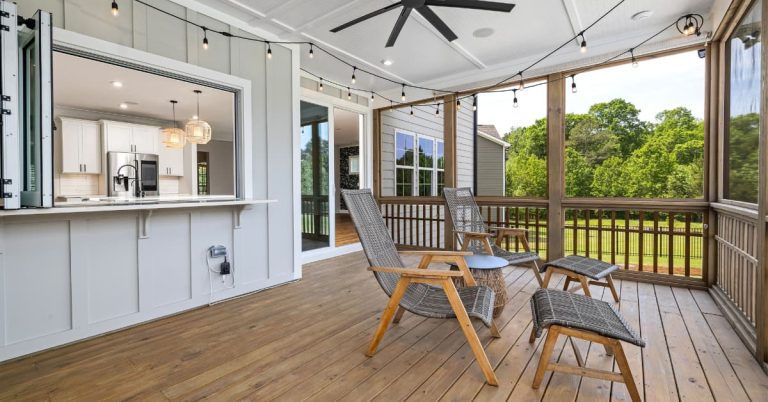
Porches serve as transitional spaces between your home’s interior and the outdoors, creating a welcoming entrance while offering protected outdoor living space. The covered nature of porches makes them usable during various weather conditions, providing shade during summer months and shelter during light rain.
Patios provide open-air spaces ideal for entertaining, dining, and enjoying direct sunshine. Their ground-level construction creates a natural flow between your indoor and outdoor living areas, particularly when connected to your home through sliding or French doors.
Structural Porch Vs. Patio Considerations: Building Requirements Compared
When evaluating porch vs. patio options, understanding the structural requirements for each is essential for planning and budgeting purposes.
Porch Construction Fundamentals
Porches represent more complex construction projects due to several factors:
- Foundation requirements to support the elevated structure
- Roof integration with existing home architecture
- Structural posts or columns for support
- Potential connection to home utilities for lighting and outlets
- Railings that meet local building codes
- Optional screen or glass enclosure systems
This structural complexity explains why porch additions typically require building permits and professional construction expertise to ensure things like proper drainage. At Blue Collar Scholars, our construction teams ensure all porch projects meet local building codes while seamlessly integrating with your home’s existing architecture.
Patio Construction Essentials
Patio construction, while generally simpler than porches, still requires careful planning and preparation:
- Ground excavation and proper drainage establishment
- Compacted base installation for stability
- Selection of appropriate paving materials for your climate
- Edge restraints to prevent shifting over time
- Grade planning to ensure water flows away from your home’s foundation
While patios don’t typically require the same level of permitting as porches, professional installation ensures proper drainage, stability, and longevity. Our Blue Collar Scholars teams excel at creating patios that withstand the variable weather conditions of the Maryland, Virginia, and D.C. regions.
Porch vs. Patio Cost Analysis: Investment Considerations
Budget often plays a significant role in deciding between a porch vs. patio. Understanding the cost factors for each option helps homeowners make financially sound decisions.
Porches typically represent higher investments due to their foundation and structural requirements, roofing materials and construction, potential electrical work for lighting and outlets, optional screening or enclosure costs, and more complex design and engineering needs.
Patios generally offer more budget-friendly options because of simpler construction requirements, no roofing or structural components, various material options at different price points, less complex permitting processes, and lower labor intensity for installation.
While specific costs vary based on size, materials, and features, homeowners should generally expect porch projects to start at a higher price point than comparable patio installations. However, both represent valuable investments in your property that can provide significant returns in terms of enjoyment and property value.
Weather and Climate Porch and Patio Considerations
The local climate plays a crucial role in determining whether a porch or patio better suits your lifestyle needs. In the Maryland, Virginia, and Washington D.C. area, our variable four-season climate influences how you’ll use your outdoor spaces throughout the year.
Seasonal Porch vs. Patio Performance: Weather Considerations
Understanding how each structure performs across different seasons can help you make the right choice for your lifestyle and local climate conditions.
Seasonal Performance Comparison
| Season | Porch Advantages | Patio Advantages |
|---|---|---|
| Spring | Protection from spring showers while enjoying fresh air | Full sun exposure perfect for enjoying early warmth |
| Summer | Shade during hot, humid months and protection from thunderstorms | Better air circulation and excellent for evening stargazing |
| Fall | Shelter from falling leaves and cooler temperatures | Beautiful connection with changing foliage and nature |
| Winter | Potential for use during mild winter days with proper enclosures | Can accommodate fire features for occasional winter use |
Year-Round Considerations
Porches extend your outdoor enjoyment beyond perfect weather days through:
- Screening options that keep insects at bay while maintaining airflow
- Potential conversion to three-season rooms with temporary glass enclosures
- Protected space for outdoor furniture that doesn’t require seasonal storage
- Consistent usability regardless of light precipitation or leaf fall
Patios offer different climate adaptations through:
- Opportunity for installing adjustable shade solutions like retractable awnings
- Ability to incorporate outdoor heating elements like fire pits or patio heaters
- Options for furniture covers rather than complete storage during off-seasons
- Versatility in adapting to different activities based on weather conditions
Many homeowners in our region enhance their patios with portable heaters, fire pits, or outdoor fireplaces to extend their usability into cooler seasons, while porch owners often add ceiling fans, screens, or partial enclosures to maximize comfort across changing weather conditions.
Porch Vs. Patio Maintenance Requirements
Maintenance needs differ significantly between porches and patios, influencing both ongoing costs and time investment.
Porch Maintenance Considerations
Porches typically require more regular maintenance. Wood components need periodic staining or painting, roofing materials require inspection and occasional repair, screens may need replacement due to wear or damage, gutter systems need regular cleaning, and structural components should be inspected for damage or wear.
At Blue Collar Scholars, our monthly maintenance services can help ensure your porch remains in excellent condition through all seasons, protecting your investment for years to come.
Patio Maintenance Needs
Patios generally require less intensive maintenance. They need periodic cleaning to remove dirt, debris, and potential staining, sealing of certain materials like concrete or natural stone every few years, weed control between pavers if applicable, repair of any shifting or settling that may occur over time, and furniture care and storage during harsh weather.
Our professional maintenance teams can provide scheduled patio cleaning and upkeep services, preserving your outdoor space’s beauty and functionality with minimal effort on your part.
Functional Porch Vs. Patio Differences: Lifestyle Considerations
Beyond structural and maintenance differences, porches and patios serve different lifestyle functions that may influence your decision.
Porch Functionality Benefits
Porches excel at providing welcoming spaces for observing neighborhood activity, protected areas for reading, relaxing, and conversation, transitional spaces between indoors and outdoors, weather-protected outdoor living areas, enhanced home security through visibility, and traditional curb appeal and architectural interest.
Many homeowners appreciate porches for their combination of privacy and connection to the surrounding community.
Patio Functionality Advantages
Patios offer different lifestyle benefits, including excellent spaces for outdoor dining and entertainment, seamless connection to gardens and landscaping, ideal locations for grills and outdoor kitchens, flexible spaces for various activities from yoga to children’s play, opportunities for water features, fire pits, and other enhancements, and private retreats away from street visibility.
The open nature of patios makes them particularly versatile for homeowners who enjoy outdoor entertaining and activities.
Porch Vs. Patio Value: Impact on Property Worth
Both porches and patios can enhance your property’s value, though in different ways.
Porch Value Considerations
Porches often provide strong returns on investment through:
- Enhanced curb appeal, particularly for front porches
- Extended living space with weather protection
- Architectural enhancement of home façade
- Appeal to buyers seeking traditional home features
- Potential for use as three-season rooms with additional enclosures
In markets where outdoor living is highly valued, a well-designed porch can recoup a significant portion of its installation cost at resale.
Patio Value Factors
Patios contribute to property value through the following:
- Creating defined outdoor living and entertaining spaces
- Enhancing the usability of yard areas
- Appeal to buyers seeking outdoor entertainment options
- Relatively low cost compared to return on enjoyment
- Compatibility with additional features like outdoor kitchens or fire pits
The ROI for patios can be particularly strong due to their lower installation costs relative to the value they add to outdoor living spaces.
Making Your Porch or Patio Decision: Blue Collar Scholar’s Expert Approach
Choosing between a porch vs. patio ultimately depends on your specific needs, preferences, and property characteristics. At Blue Collar Scholar, our consultative approach helps homeowners make informed decisions through several key steps.
First, we conduct comprehensive site evaluations to assess your property’s potential. We then engage in in-depth discussions about your lifestyle needs and outdoor living goals. Our team provides detailed presentations of design options that complement your home’s architecture. We also offer transparent cost analysis for different material and design choices. Throughout the process, we provide expert guidance on permits and regulations specific to your locality.
Our experienced design and construction teams work collaboratively with you throughout the process, ensuring your new outdoor space exceeds expectations while respecting your budget and timeline.
FAQs About Porches vs. Patios
Can I convert my existing patio into a porch?
Converting a patio to a porch is possible but represents a significant project. The process typically involves adding a foundation, structural supports, and a roofing system. Professional contractors can assess your existing patio to determine feasibility and provide conversion options that meet your needs and local building requirements.
Which is better for resale value, a porch or a patio?
Both can enhance resale value, but front porches typically offer a stronger curb appeal impact. However, well-designed patios with features like outdoor kitchens or fire pits can be equally appealing to potential buyers. The best choice depends on your neighborhood norms, home architecture, and the quality of the installation.
Do porches and patios require different permits?
Yes, typically, porches require more extensive permitting due to their structural components and connection to the home. Patios generally need fewer permits, though regulations vary by locality. Professional contractors can manage all permitting processes, ensuring compliance with local codes.
How long do porches and patios typically last?
With proper construction and maintenance, a quality porch can last 20-30 years before needing significant renovation. Well-built patios often last 15-25 years before requiring major repairs, depending on the materials used and environmental conditions. Professional construction methods prioritize longevity and durability for both porch and patio projects.
Partner with Blue Collar Scholars for Your Perfect Outdoor Space
Whether you’re leaning toward a classic front porch that welcomes guests or a versatile backyard patio for entertaining, Blue Collar Scholars offers the expertise, craftsmanship, and ongoing support needed to create your ideal outdoor living space.
Our comprehensive approach combines design vision with practical construction knowledge, ensuring your new porch or patio not only meets your immediate needs but continues providing enjoyment for years to come. From initial concept through construction and beyond, our team is committed to excellence at every step.
Ready to transform your outdoor living space with a beautiful new porch or patio? Contact Blue Collar Scholars today for a consultation and discover how our expertise in construction, remodeling, and maintenance can create the perfect outdoor extension of your home!