

If water keeps showing up where it should not, such as in your basement, along your foundation, or pooling in your yard, you are not dealing with bad luck. You are dealing with a drainage problem.
A properly designed French drain system controls both surface water and groundwater. It gives water a defined path away from your home and reduces long term structural risk. Here is what it is, how it works, and how to know when your property needs one.
What Is a French Drain?
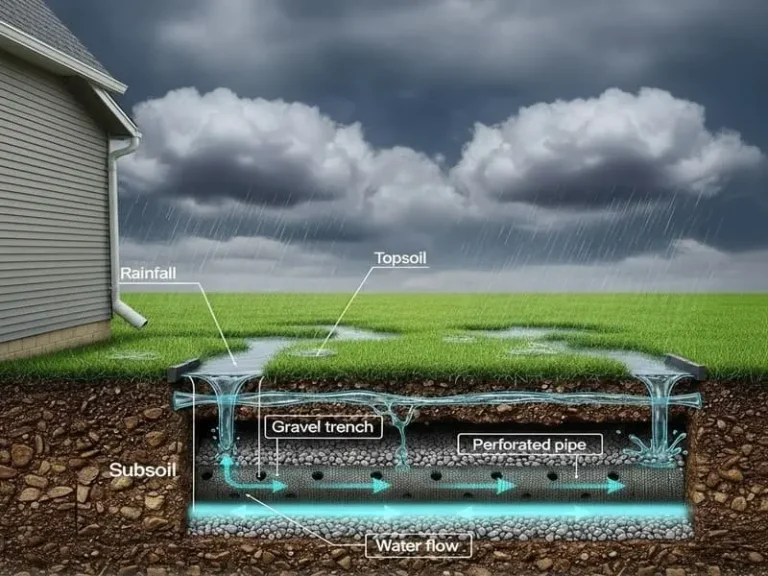
A French drain is a sloped trench filled with gravel that often contains a perforated pipe. The system redirects water away from areas where it collects and causes damage.
At its core, a French drain includes:
- A trench dug along a problem area
- Washed gravel or stone
- A perforated pipe, often called weeping tile or drain tile
- Filter fabric to prevent clogging
- A designated discharge point
You may also hear it referred to as a perimeter drain, footing drain, or trench drain. These names describe variations in placement, but the purpose remains the same. Water is directed through the trench instead of collecting near the foundation.
Unlike an open ditch, a French drain works below the surface. Hydrostatic pressure is reduced as water is moved away from the structure.
How Does a French Drain Work
Water follows the path of least resistance. A French drain system creates that path intentionally.
The system works through several coordinated steps:
- The trench is installed with a slight slope.
- Gravity pulls water downhill.
- Gravel creates open space that allows water to move quickly.
- The perforated pipe collects subsurface water.
- Filter fabric blocks soil and roots.
- Water exits at a safe discharge point.
Proper slope drives the entire system. Without it, water cannot move effectively.
When installed correctly, the pipe holes face downward. Groundwater enters from below and flows into the pipe. The surrounding gravel allows water to travel faster than it would through compacted soil. Clogging is reduced when fabric is installed correctly.
Rain is not eliminated. Instead, water is controlled and redirected.
Types of French Drain Systems
In Maryland, Washington, D.C., and Virginia, no two homes have the same water issues. Each problem requires a specific drainage approach. The right system depends on where the water is coming from.
Open French Drains
An open French drain consists of a gravel filled trench that remains visible at the surface. In many properties, an open French drain often called a river gravel swale is used to move surface runoff across a yard in a controlled, natural looking way.
- Gravel is exposed instead of covered with soil
- Surface runoff enters immediately
- Common along driveways, slopes, and property edges
- Easier to inspect and maintain
Open systems capture visible water quickly. They prioritize function while still blending into landscaping when designed properly.
Buried Closed French Drains
A buried French drain is covered with soil, sod, or landscaping after installation.
- Pipe and gravel are installed below ground
- Both surface and subsurface water are managed
- Lawn appearance is preserved
- Common near foundations and within yard drainage systems
This system works below grade and blends into the property. In many cases, buried systems are paired with proper yard grading so water naturally flows toward the drain instead of toward the home.
Interior French Drains
An interior French drain is installed along the inside perimeter of a basement floor.
- Pipe sits beneath the slab
- Water is collected where the wall meets the floor
- Flow is directed to a sump pump system
- Used when water already enters the basement
Interior systems manage intrusion after it occurs. Water is redirected before it spreads across the basement floor.
Exterior French Drains
An exterior French drain is installed outside the foundation at footing level.
- Groundwater is intercepted before it reaches the wall
- Hydrostatic pressure is reduced
- Excavation is required Designed as a preventative solution
This approach protects the foundation at its source. Water is intercepted before interior damage can occur.
When Do You Need a French Drain System?
Drainage problems rarely improve without correction. If you notice the following issues, a French drain system should be evaluated:
- Basement flooding after heavy rain: Groundwater pressure builds around the foundation during storms.
- Standing water for more than 24 to 48 hours: Soil remains saturated, loses stability, and creates conditions that can attract mosquitoes and increase foundation risk.
- Erosion near the foundation: Moving water removes supporting soil.
- Persistent damp or musty odors: Moisture intrusion may already be occurring.
- Foundation cracks linked to water pressure: Walls are stressed when water builds against them.
- A yard that slopes toward the house: Gravity consistently moves runoff toward the foundation.
Often, drainage corrections involve more than one strategy. Surface runoff patterns, soil composition, and elevation changes all play a role in determining the right solution.
Brief Overview of French Drain Installation
Each property requires a customized drainage plan. However, the French drain installation process follows a clear, proven structure.
The standard steps include:
- Identifying the drainage path and discharge point
- Excavating a properly sloped trench
- Installing a gravel bedding layer
- Placing perforated pipe with holes facing downward
- Surrounding the pipe with additional gravel
- Wrapping the system in filter fabric
- Backfilling or leaving exposed depending on design
Slope and discharge planning determine performance. If the outlet is poorly chosen or the pitch is incorrect, the system will fail.
At Blue Collar Scholars, we handle French drain installation directly. We are experienced yard drainage contractors who evaluate grading, soil conditions, and water movement patterns before building a system designed for long term performance.
The Bottom Line
A French drain system works because it controls how water moves.
- Open systems capture surface runoff quickly.
- Buried systems manage groundwater discreetly.
- Interior systems control basement intrusion.
- Exterior systems prevent intrusion before it happens.
Long term success depends on design accuracy, correct slope, proper materials, and careful installation.
When rainfall becomes a recurring concern, the issue is not the weather. The issue is drainage. A properly built French drain system directs water away from your home and protects your foundation for years to come.
At Blue Collar Scholars, we build drainage solutions that solve the problem at its source. If water keeps showing up where it should not, schedule a drainage assessment with our team and get a plan built specifically for your property.